
In June 2026, CulturePolis celebrates 20 years of activity, and on the occasion of this important anniversary, we welcome you to the first of a series of short publications, highlighting different stages of our journey.
Whether you have been with us from the very beginning, met us through various initiatives over the past 20 years, or are connecting with us for the first time, we would like to invite you on a journey of reflection: from the years that shaped our identity, to our future plans for the creation of CorfuGen: Centre for Culture, Sustainability & Innovation, designed to host innovative initiatives in culture, experiential learning, environmental education, and social innovation in Corfu.
2006-2010: The Original Idea and the First Steps
CulturePolis was officially founded in 2006; however, the idea had already begun to take shape in 2004 by the organization’s founder and president, Dr. Vasilios Laopodis. The inspiration for CulturePolis emerged in Brussels –where he was serving at the European Commission— through his active involvement in the organization “Europe of Cultures Forum”.
About the Founder
With an academic and professional background in the sciences and new technologies, shaped by studies and work experience in Greece and abroad, he returned permanently to Greece in 2006 and founded a new Civil Society Organization with a primary focus on culture, inspired by Corfu’s prominent status as a UNESCO World Heritage Site. The organization was established as a Non-Profit Civil Company, based in Corfu, under its original name “Forum of the Europe of Cultures: Adriatic – Ionian Branch.” The Forum, as we used to call it, reflected the founders’ vision at the time: a Greece taking on a leading role in a Europe built upon the cultures of its Member States.
The Vision
The organization’s core mission was —and remains— to contribute through research, analysis, dialogue, and targeted actions aimed at informing and raising awareness among institutions and the public on issues related to:
- culture and the arts in their broadest sense,
- intercultural dialogue and the promotion of diverse cultural identities in each place,
- sustainability in all its forms,
- the promotion of innovative approaches and new technologies in society and the economy,
- creative economy and entrepreneurship.
Guided by this philosophy, CulturePolis began its work and gradually undertook significant initiatives, aiming to create an open space for collaboration and participation, where culture, sustainability, innovation, and cultural diversity serve as a common foundation for dialogue, the exchange of ideas, and the connection of Greece with European and international networks.
Early Initiatives
2006
2008
2008-2010
2008-2012
2009
2009-2010
Reflections
Two decades on, we invited the organization’s founder to revisit that early period and share, with honesty and the benefit of hindsight, what worked, what didn’t, what could have been done differently, and how he now assesses the course of the original vision.
What worked and what didn’t
What we initially achieved in Corfu, and gradually in neighboring regions of Greece and nearby countries, was to raise awareness among society and its institutions —both public and private— of the importance and necessity of protecting local cultural identity, the need for sustainable cultural management in the region, and the importance of outward-looking, open initiatives.
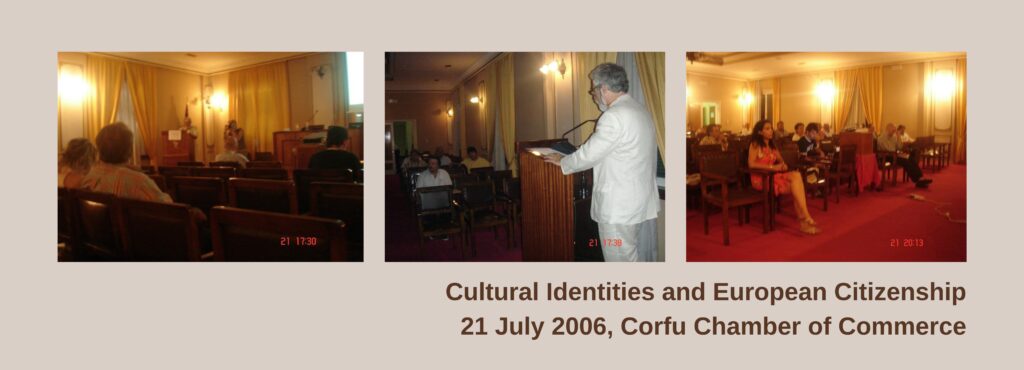
In doing so, we attracted public interest through flagship actions such as the local events themed “Cultural Identities and European Citizenship” (2006), “Fortress Cultural Encounters” (2009–2011), and “Get Culturally Connected” (2008–2010), among others. These initiatives then led audiences toward international actions that were unprecedented for the local community, such as the “Arab World Festival: The West Meets the East,” the “1st Adriatic –Ionian Intercultural Dialogue Conference” (2008), as well as initiatives beyond Greece, such as in Syria with the project “CultLink – Arts and Crafts: A Gateway to Dialogue and Diversity” (2009). Through these efforts, this vision was carried forward to other regions of Greece and the Balkans.
Unfortunately, following the global and Greek economic crisis from 2009 onwards, priorities shifted and we were forced to recalibrate, focusing our actions on more institutional —yet equally important— issues. These included the sustainable management of Corfu as a UNESCO World Heritage Site, intercultural dialogue with developing nations, universal access to culture, creative and cultural entrepreneurship, digital transformation, cultural tourism, and new technologies. With the establishment in 2020 of the Hellenic and Arab Centre for Literature and Culture, we expanded our activities to the MENA region (Middle East and North Africa), focusing on promoting reading and literary translation.
Following the pandemic, we turned our attention to new and pressing societal challenges such as combating online misinformation, digital literacy, and the smart cities of the future… and we continue!
We are proud that over these 20 years, we have completed more than 50 projects and initiatives, leaving a positive impact on citizens and institutions alike.
What we would have done differently
From the outset, we would have sought to better leverage both citizen participation and the attraction of European and national funding to create a physical reference centre in Corfu for cultural and educational activities in the fields of culture, sustainability, and innovation —one that would serve as a refuge in difficult times, which we knew were certain to come. Circumstances and missed opportunities in securing funding did not allow this to happen. Nevertheless, the seed planted back then is now ready to bloom, as our focus in the coming period turns toward the creation of the CorfuGen Cultural and Educational Centre in Corfu.
The original vision, 20 years on
Twenty years later, we believe that the vision of a Europe of Cultures was not fully realized, having been overtaken by more economically driven approaches among EU Member States. Nevertheless, the overall imprint of CulturePolis can be considered entirely positive, as reflected in the many significant projects and policy initiatives we successfully implemented over the course of these two decades.
From January to March 2026, we shared a weekly project spotlight selected from the actions of CulturePolis; we invite you to explore them by following us on social media and searching for #20yearsCulturePolis #ProjectSpotlight.
Thank you for being by our side on this journey.